Wispr Flow ranks #23 of 28 AI meeting assistants we tested in 2026, scoring 3.4 out of 5. The most interesting new entrant of 2026: a real-time-capable, bot-free notetaker with unusually accurate name handling, held back by desktop-only availability, an opt-out training default on individual plans, and an unproven analysis layer. Pricing starts at $15/mo with a free tier available. Available on Mac, Windows.
Wispr Flow Key Facts
Checked against vendor documentation October 14, 2026- How it records
- Bot-free desktop app on Mac and Windows records computer audio; no bot joins the call
- Where AI processing runs
- Cloud, in the US: transcription and AI run on Wispr Flow's servers
- Works offline
- No — needs an internet connection
- Trains on your data
- Yes by default on Free and Pro (opt out in Settings); off and locked on Growth and Enterprise
- Transcription languages
- 21 for Notetaker
- Free plan
- Limited Notetaker with a weekly meeting limit (recordings under 5 minutes don't count), plus 2,000 dictation words a week
- Paid plans from
- $12/mo billed annually ($15 monthly) for Pro
- In-person meetings
- Partly — one-tap desktop capture of unscheduled conversations; no mobile notetaker
- Real-time features
- Live transcript, "What did I miss?" catch-up, and pre-meeting briefs
- Compliance
- SOC 2 Type II, ISO 27001; US processing, no EU residency; a HIPAA BAA disables Notetaker
Compare every tool on these facts in the AI meeting assistant fact sheet, or see the best Wispr Flow alternatives.
Rating Breakdown
Strengths
- + Live transcript during the call plus an on-demand "catch me up" summary, which most bot-free tools lack
- + Personal dictionary carries over from Flow's dictation product, so acronyms and product names are spelled right
- + Speaker names pulled from calendar invites rather than guessed
- + Bot-free capture with no participant notification and no platform permissions to negotiate
- + Genuine free tier including the notetaker, and $12–15/month bundles dictation and meetings together
Weaknesses
- – Notetaker is desktop only (Mac and Windows); there is no mobile notetaker for in-person meetings
- – Launched in August 2026, so the AI analysis layer is less mature than established competitors
- – Training is on by default for Free and Pro users, so the setting has to be found and changed; only Growth and Enterprise lock it off
- – A signed HIPAA BAA disables Notetaker entirely, so it cannot be used for regulated meeting data
- – No offline capability — capture is local but AI processing runs in Wispr Flow's cloud
- – Free plan carries a weekly meeting limit
Our Verdict
The most interesting new entrant of 2026: a real-time-capable, bot-free notetaker with unusually accurate name handling, held back by desktop-only availability, an opt-out training default on individual plans, and an unproven analysis layer.
Wispr Flow spent three years building a very good AI dictation tool, and in August 2026 it shipped a meeting notetaker built on the same foundations. That heritage shows up in the places that matter, and it explains why a brand-new product lands mid-table rather than at the bottom.
The company’s chief executive, Tanay Kothari, called 2026 “the year of meeting recorders and notetakers,” which is both true and a fair description of how crowded the field Wispr just entered has become. What makes this launch worth attention is not that it exists, but that it does two things the incumbents mostly do not.
Key Features
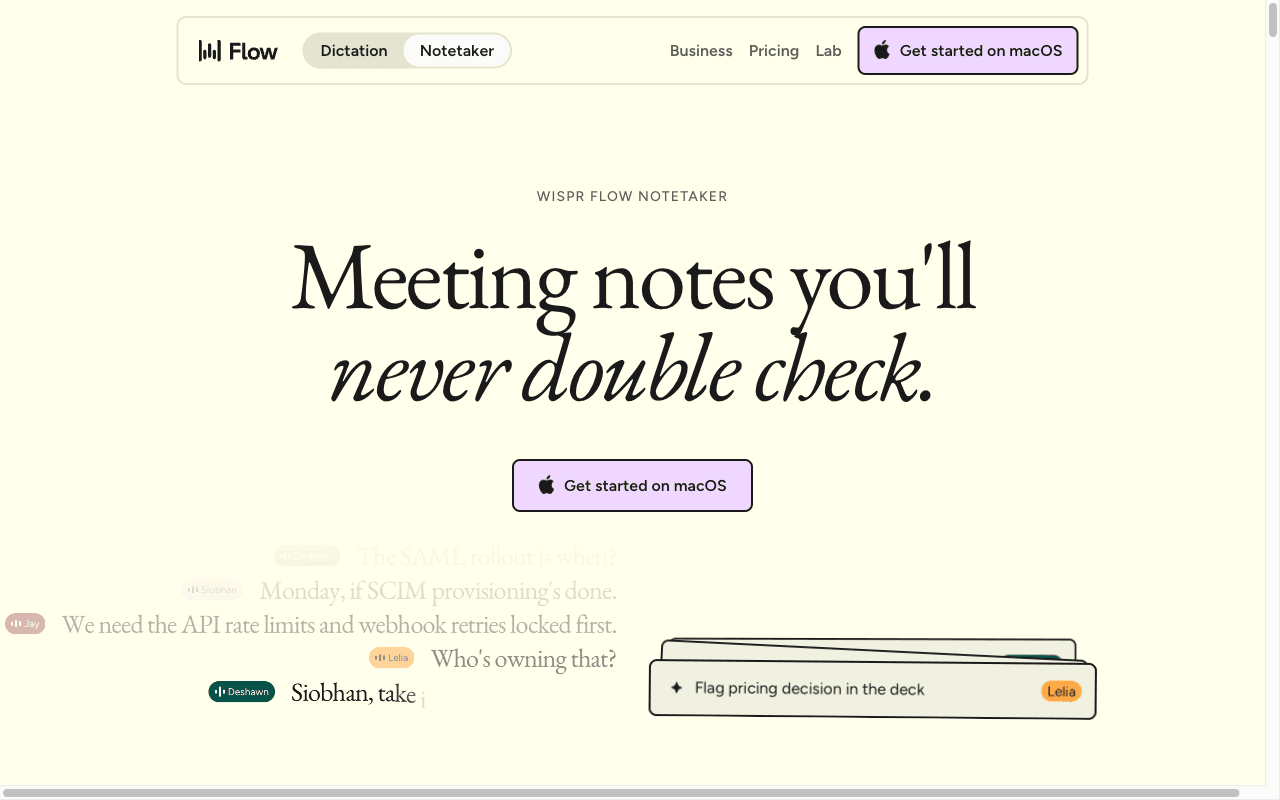
The first is names. Almost every notetaker mangles product names, acronyms, and jargon, and almost every one guesses at who is speaking. Wispr Flow carries over the personal dictionary from its dictation product, so the vocabulary you have already trained follows you into meetings, and it pulls speaker names from the calendar invite rather than inferring them from voice. These sound like small things. In practice they are the difference between a transcript you can paste into a document and one you have to clean up first, and they are the clearest evidence that this was built by people who had already solved the hard part of speech capture.
The second is that it works during the meeting. You see a live transcript as the call runs, and you can ask the AI to catch you up on what you missed — the moment you rejoin after being pulled away, or realise you have not been listening for four minutes. Most bot-free notetakers, including Granola, Jamie, and Circleback, are strictly post-meeting products. Wispr Flow is not, and that is why it scores a 4 on real-time capability where those tools score a 1 or 2.
Beyond that it does the expected things: cleaned-up transcripts, action items, and querying across your meeting history. There is MCP access, with setup guides for Gemini, Claude, and ChatGPT, which is a forward-looking touch for anyone wiring meeting data into their own models.
The product has moved quickly since launch. In September 2026 Wispr added imports from Otter and Granola, Windows support, Outlook calendar, transcription in 21 languages, pre-meeting briefs, and an org-level consent confirmation. In August it raised $280M at a $2B valuation, partly to fund the notetaker.
The AI analysis layer is still the least proven part. Summaries and action items are competent but not distinctive, which is what you would expect from a product a couple of months old. We score it a 3 and expect that to move.
Pricing
The free plan includes limited Notetaker access with a weekly meeting limit (recordings under five minutes do not count) and 2,000 dictation words a week. That is a real free tier, not a five-meeting trial, and it is more generous than Bluedot’s lifetime cap, though Circleback’s new free plan, with unlimited meetings and 30 days of history, now goes further on meeting volume.
Pro is $15 per user per month, or $12 billed annually, and bundles unlimited dictation alongside longer meeting retention, better AI models, and priority support. The bundling is the pricing story. If you were already paying for a dictation tool, the notetaker is effectively free; if you were already paying for a notetaker, the dictation is. Against Circleback’s $15 annual Pro and Bluedot’s $32 Business tier, that is a strong position.
Growth, a self-serve team plan added in August 2026, starts from $18 per user per month billed annually. Enterprise adds SAML SSO, SCIM, audit logs, and MDM. Wispr now calls the Notetaker enterprise-ready: an org-wide admin toggle arrived in August, access and privacy controls in September, and audit logs of who accessed which transcript in October 2026.
Privacy & Security
Capture happens locally and no bot joins your call, so participants get no automatic notification and there is nothing for a meeting host to admit from a lobby. That is the same posture as Granola, Jamie, and Circleback, and it carries the same obligation: disclosure is on you.
The AI processing runs in Wispr Flow’s cloud. Marketing language about Flow working “right on your device” describes the capture and the dictation path, not the meeting analysis pipeline, and we want to be precise about that distinction because it is exactly where buyers get misled. This is a cloud tool with local capture. It will not work on a plane, and meeting content does leave your machine.
On model training, Free and Pro users are opted in by default through an “Improve the model for everyone” setting they can switch off. Since October 2026 training is off and locked on the Growth and Enterprise team plans. That is meaningfully better than it was and still weaker than the no-training commitments Circleback and Jamie publish for every user, because individuals start opted in and most people never change a default. We score it a 4 rather than a 5 for that reason.
Processing happens in the US, with no EU data residency option. Uploaded audio is deleted seven days after upload; transcripts are kept until you delete them. Wispr Flow holds SOC 2 Type II and ISO 27001. The HIPAA position needs reading carefully: a signed personal or organisation BAA blocks Notetaker recording, and Wispr’s pricing page says Notetaker is disabled on BAA accounts. A BAA covers dictation, not meetings, so this is not a tool for regulated meeting data.
Best For
Wispr Flow suits individual professionals and small Mac or Windows teams who want one tool for dictation and meetings, who value getting names and jargon right, and who want live in-meeting support without a bot. Writers, consultants, founders, and anyone whose vocabulary defeats ordinary transcription will get disproportionate value from the personal dictionary.
It is a poor fit for anyone who needs to record in-person meetings on a phone, for organisations that need EU data residency, and for healthcare teams, since a HIPAA BAA switches the Notetaker off.
How Wispr Flow Compares to Hedy
These two are closer in intent than most pairings in our rankings, because both refuse the premise that a notetaker should only be useful after the meeting ends. Both capture without a bot, both do something live, and both are priced for individuals rather than procurement departments.
Hedy goes considerably further on both axes that define the category. Its real-time layer is coaching rather than catch-up: it surfaces strategic questions and follow-ups while the conversation is running, which is a different and harder problem than summarising what you missed. And its privacy architecture is structural rather than contractual — the full transcription and analysis pipeline can run on-device on supported hardware, so sensitive conversations need not reach any vendor, which is why Hedy scores a 5 on offline capability against Wispr Flow’s 1.
Platform coverage is the other gap. Hedy runs on iOS, macOS, Android, and Windows. Wispr Flow’s Notetaker now covers Mac and Windows but not phones, so it cannot record an in-person meeting from your pocket.
Where Wispr Flow genuinely wins is transcript fidelity on difficult vocabulary. The personal dictionary carried over from a mature dictation product is a real asset, and if your meetings are dense with product names and acronyms, it will produce cleaner raw text. It is a young product from a team that clearly knows speech. We expect it to keep climbing these rankings as the analysis layer matures.